
The complete guide
How To Choose A Hard Shell Camera Backpack For Travel And Street Shooting
What soft bags do not stop
Most camera bags are fabric over foam. They are light, they flex to fit a crowded shelf, and for gentle use they are fine. The weakness shows in a crush. On a packed train at peak hour, bodies and bags press in from every side. In an overhead rack, someone's cabin case gets shoved against yours. At a kopitiam table, the bag tips off a stool and lands on a corner.
Foam softens a blow, but fabric walls still fold inward. If a lens sits where the wall folds, the lens takes part of the load.
A hard shell camera backpack is one answer to that. The outside holds its shape, so pressure spreads across the shell instead of pushing into one spot. This guide explains what that does and does not do, and how to judge whether this bag fits your kit.
What a hard shell does, and what it cannot promise
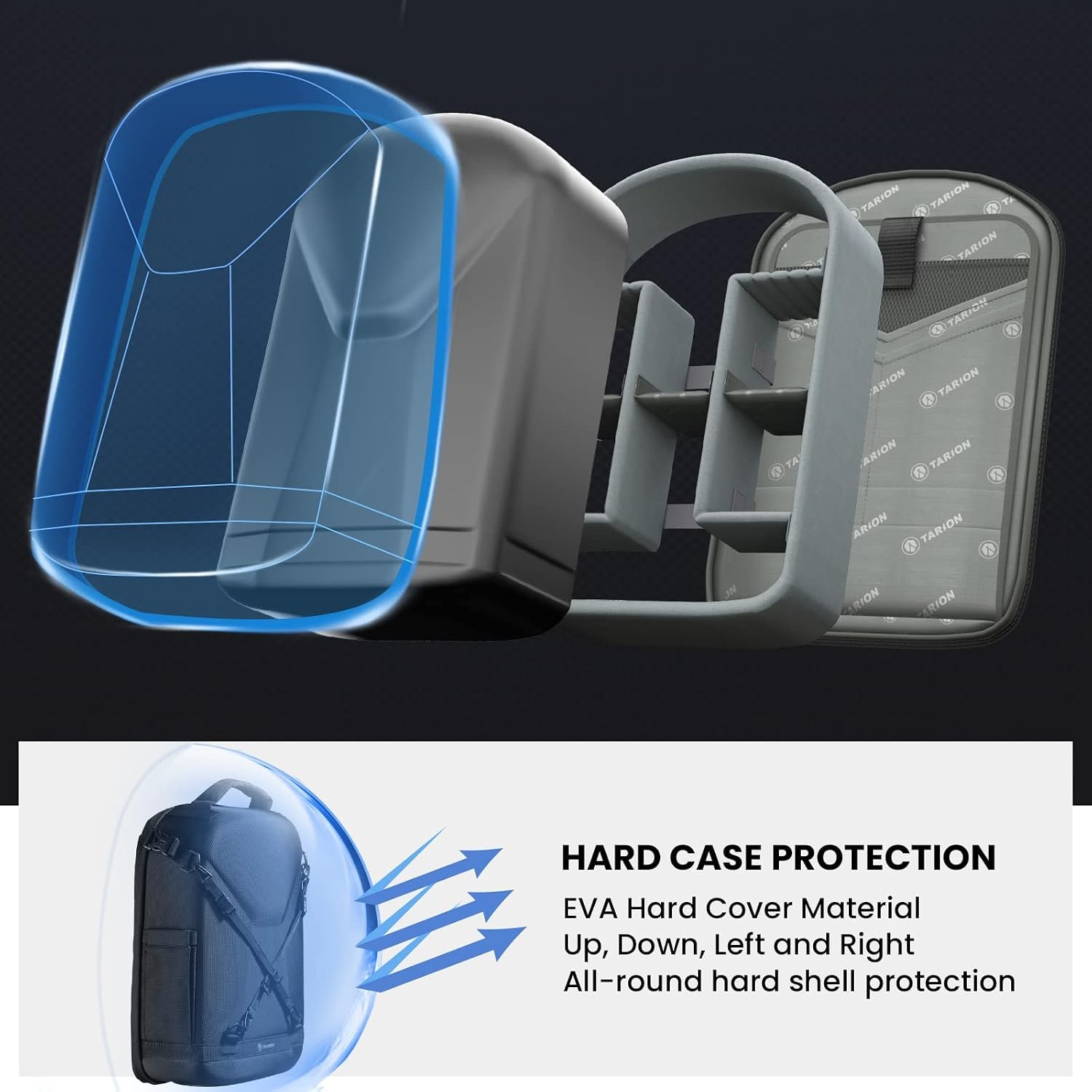
This bag's shell is EVA, moulded in one piece, with thick padding inside. The maker also lists 1200D nylon and polyester among the materials. EVA is a dense foam that sets into a firm, slightly springy form. It is the same family of material used for many hard-sided equipment cases.
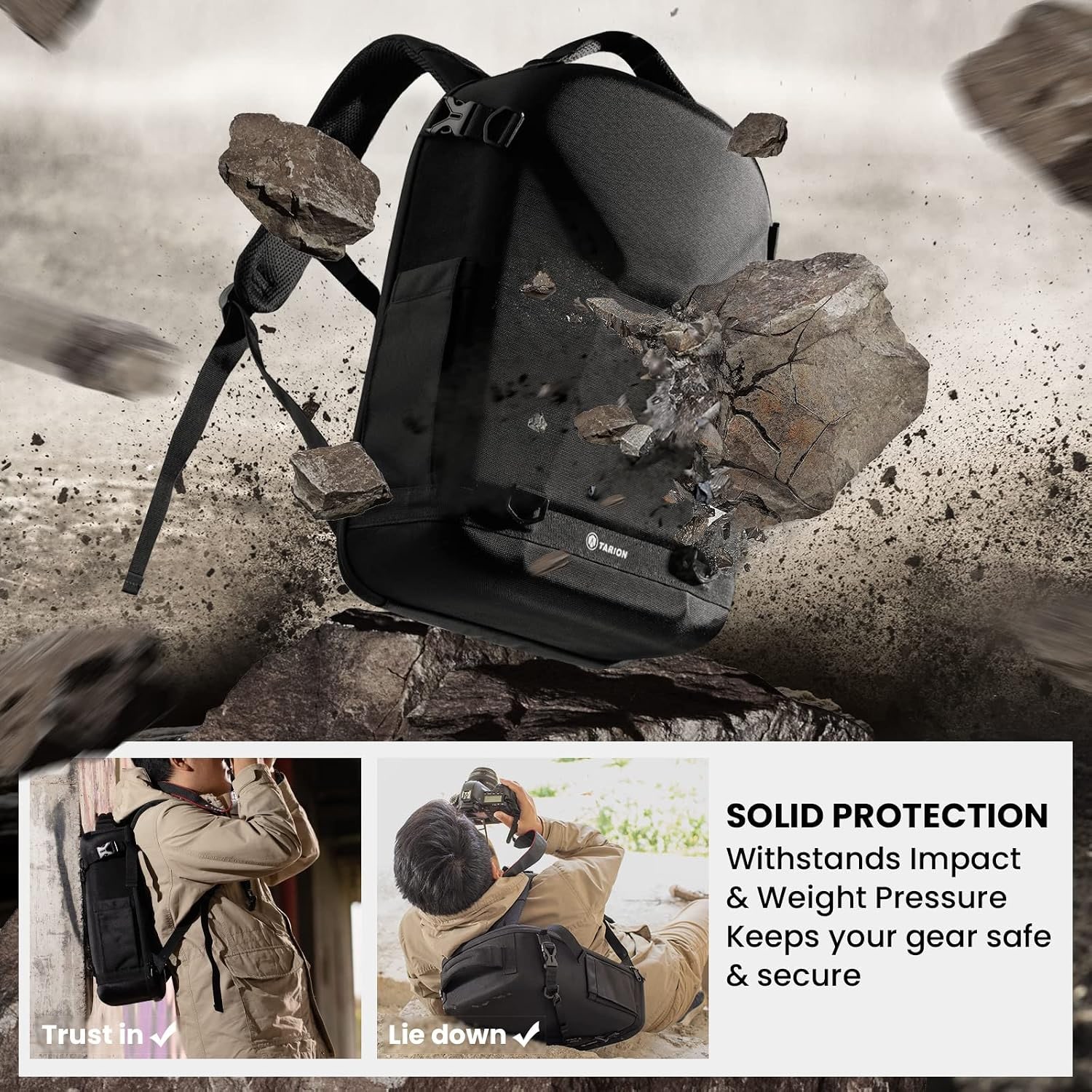
The maker describes the shell as shockproof, resistant to water and abrasion, and able to withstand heavy pressure. Read that sensibly. A shell like this handles the ordinary abuse of travel well: knocks, scrapes, being leaned on, being stacked under another bag.
It is not a guarantee for the contents. Drop any bag far enough onto concrete and a lens can still suffer, because the shock travels through to whatever is inside. So use the dividers properly, keep heavy items from resting on fragile ones, and treat the shell as the first layer of defence and not the only one.
There is also a practical trade. A rigid bag does not squash to fit a small gap. Its outside size is its size, always.
Rear access, and why the opening faces your back
The camera and laptop compartment opens only from the back panel, with double zips. To get at your gear, you take the bag off, lay it front-down and unzip the panel.
That design has two effects. While you wear the bag, the zips sit against your back, out of easy reach of anyone standing behind you on an escalator or in a queue. And when you set the bag down to open it, the front shell is what touches the ground. The padded panel that goes against your shirt stays clean and dry, which you will appreciate on a wet pavement.
It does not make the bag theft-proof. No design does, and you should watch your bag in a crowd as you normally would. The cost of rear access is speed. If you like to swing a bag round and grab a camera in three seconds, this style is slower.
Reading the capacity honestly
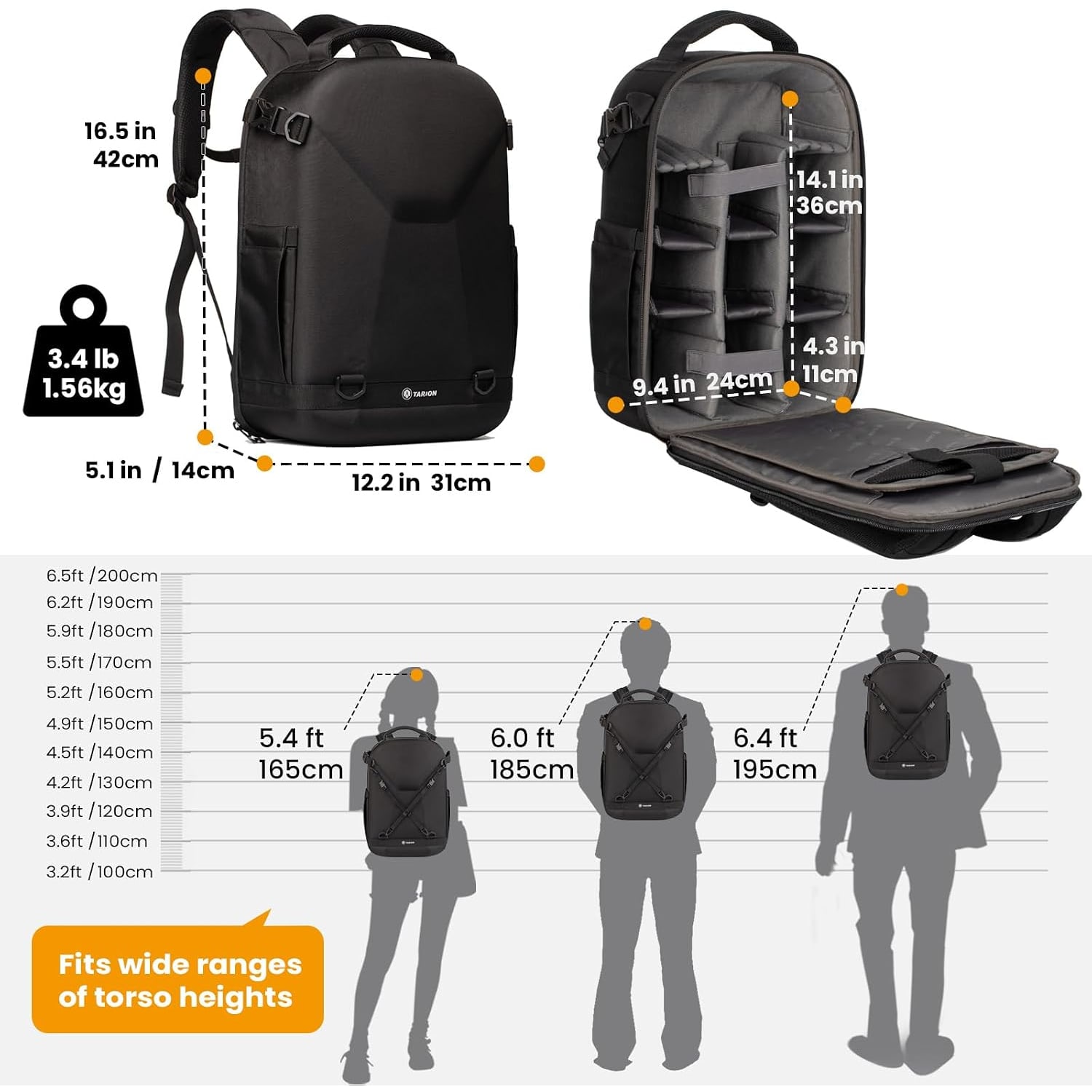
The numbers for this bag are modest. Inner volume is 10 to 12 litres. Outside dimensions are about 31 x 14 x 42 cm. Empty weight is 1.5 kg.
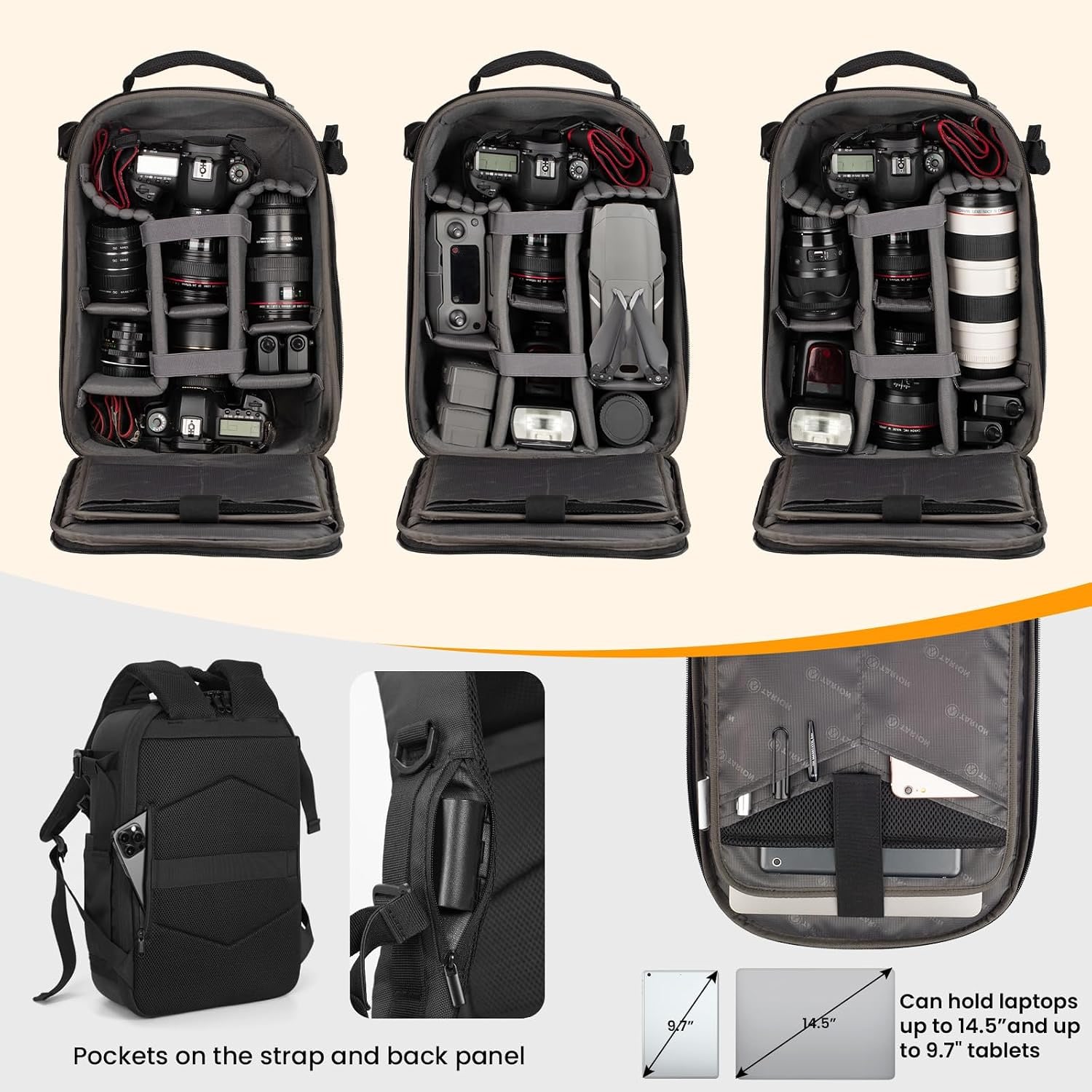
The maker says it holds 1 to 2 cameras, 5 to 6 lenses and accessories. That is possible with small prime lenses and compact bodies. It is optimistic if your kit includes a large telephoto zoom. A simple way to check is to lay your kit on a table inside a rectangle of about 31 by 42 cm, and remember the bag is around 14 cm deep on the outside, with the laptop sleeve taking some of that.
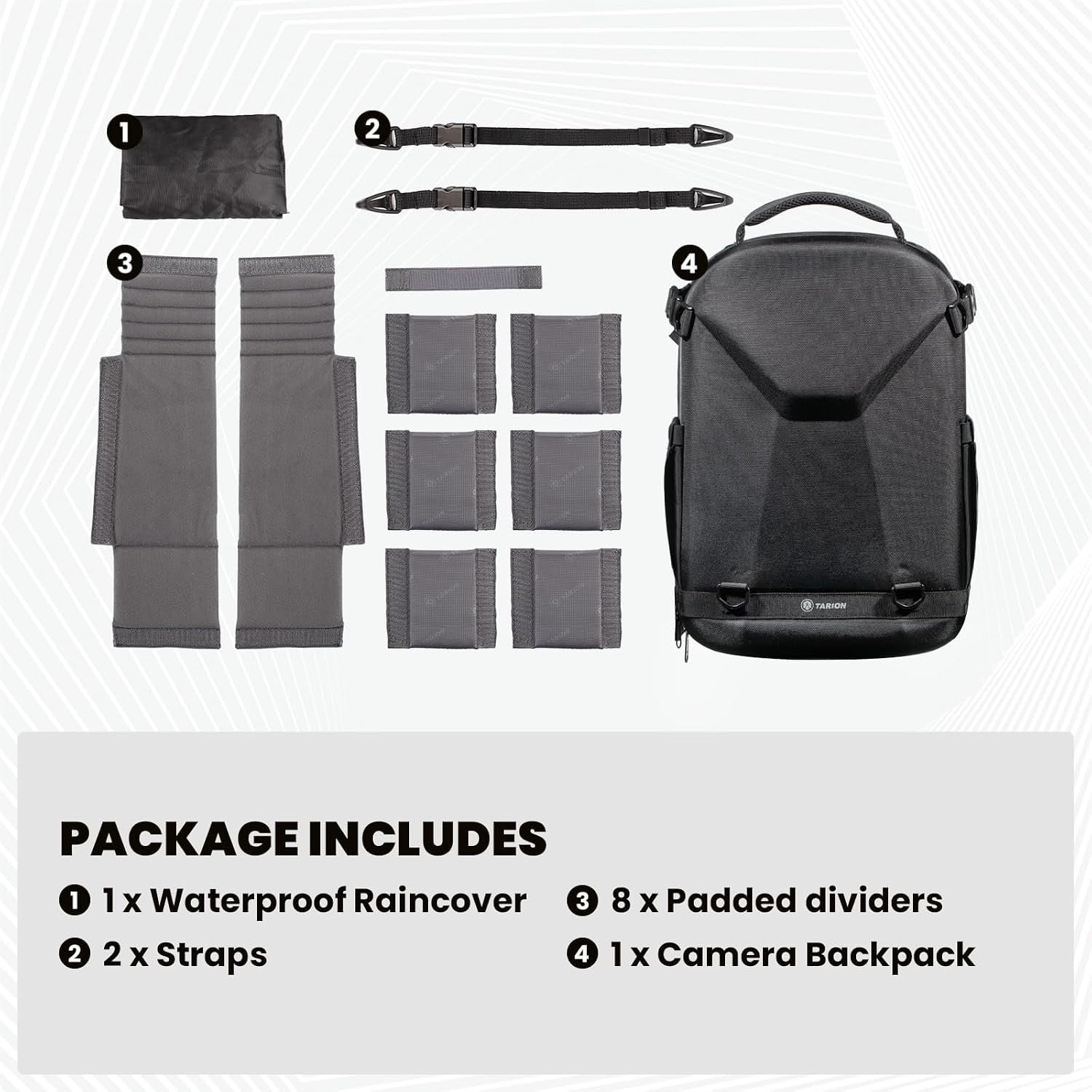
The dividers are modular, so you can shift them to match your gear. The maker does not state how many are supplied or the inside measurements of the compartment. If you carry one long lens mounted on a body, ask us before ordering.
For most people a pack this size works as a day bag: a body or two and the lenses you expect to use that day, with batteries and filters in the gaps.
Packing it so the shell can do its job
How you load a hard bag matters. Put the heaviest item, usually the camera body with a lens attached, in the middle of the compartment and close to the back panel. Weight carried high and near your spine feels lighter than the same weight hanging low and away from you.
Fit the dividers snugly so nothing can slide. A lens that rattles in a loose slot knocks against its neighbours with every step, shell or no shell. Stand lenses on their rear caps where the depth allows, and keep small hard objects such as chargers and spare plates out of the camera compartment. The back pockets are the place for those.
Laptop, tablet and everything else
On the back there is a sleeve for a laptop of up to 14.5 inches, plus pockets for a tablet and small accessories. The specifications list five compartments in total.
Check your laptop's real width, not just its screen size. Two 14 inch laptops can differ by a couple of centimetres across the body. The bag is about 31 cm wide on the outside.
Bear in mind what a laptop does to the load. A 1.5 kg bag plus a laptop, a camera and several lenses adds up quickly. Weigh the packed bag once so you know what you are carrying.
Tripods, drones and the front straps
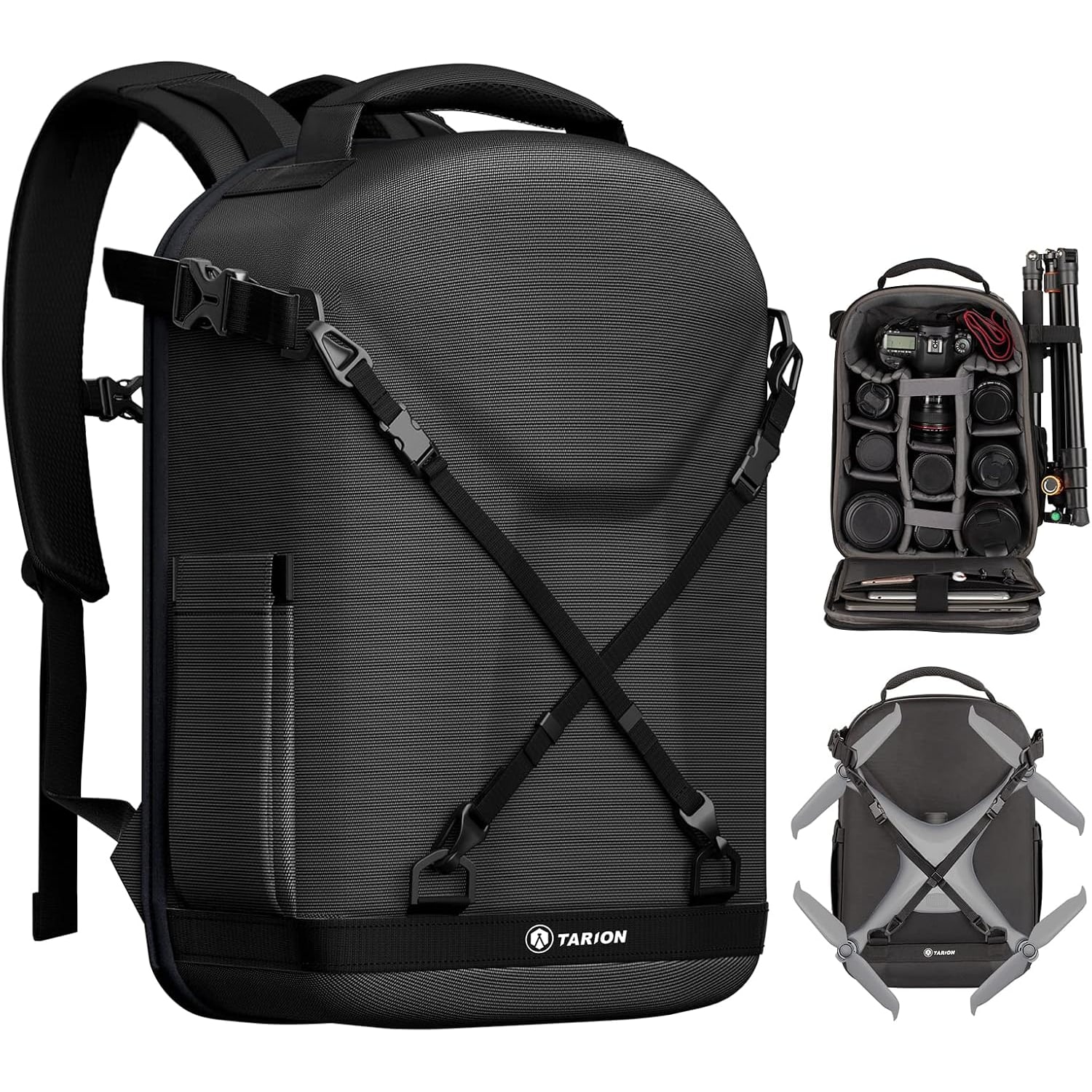
The sides have pockets for a tripod and accessories, with straps to hold them. Because the bag is 42 cm tall, a compact travel tripod sits better than a full-height one.
On the front, two X-cross straps fasten with quick release clips and tighten with buckles. They are there for bulky items that will not go inside. The maker gives a larger drone and a lens bag as examples. A light rain jacket rolls up under them just as well.
Rain and humidity
Here, rain is the daily risk. The maker describes the shell as water resistant, and a separate waterproof rain cover is included. Use both. A shell sheds a shower, but zips are where water finds its way into any bag, and a tropical downpour is more than a shower. Keep the cover in the bag and pull it on early.
Humidity is a different problem, and no backpack solves it. Lenses left for weeks in a closed bag in a humid room can grow fungus. Unpack at home. Store lenses and bodies in a dry cabinet, or in a sealed box with silica gel, and let the bag air out with its zips open after a wet day.
Carrying comfort
The back panel and shoulder straps are padded, with what the maker calls an air-grille design to spread weight and let some air through. A chest strap helps hold the straps in place when the bag is full. The maker does not mention a waist belt, and does not state a maximum load.
A firm shell sits differently on the back from a soft bag. It does not mould to you, so the padding matters more. Adjust the shoulder straps so the bag rides high and close, and use the chest strap on longer walks. In our heat, any backpack means a warm back, and airflow channels help only a little.
Flying with it
The maker does not claim approval from any airline. What you have are the outside dimensions, about 31 x 14 x 42 cm, and a shell that will not compress. Compare those with your airline's cabin and under-seat limits before you travel, since they vary by carrier and ticket type. The web handle on top helps when lifting the bag into a rack.
Who it suits, and who should look elsewhere
This bag suits street, travel and event photographers who move through crowds and want firm walls round a compact kit. It also suits anyone who carries a camera and a laptop to work and has had enough of soft bags getting crushed on the commute.
Look elsewhere if you carry two bodies with large zooms, since 10 to 12 litres will not hold them. Choose a side-access sling if you need a camera in hand within seconds. And if you want a bag that folds flat for storage, a hard shell is the wrong type.
Care
Wipe the shell with a damp cloth. Air the bag with the zips open and never machine wash it. Shake grit out of the dividers, because sand scratches lens barrels. Dry the rain cover before folding it back in.
The short version
A hard shell camera backpack trades a little weight and flexibility for walls that hold their shape. This one has a one-piece EVA shell, rear access with double zips, modular dividers, a 14.5 inch laptop sleeve, side tripod pockets, front X-cross straps and a rain cover. It is 10 to 12 litres inside, about 31 x 14 x 42 cm outside, and 1.5 kg.
Lay your kit out, measure your laptop, and be realistic about lens sizes. If it all fits, this is a tidy, firm-sided day bag for city and travel shooting.