
The complete guide
How To Choose An Industrial Endoscope With A Screen
When the fault is five metres away
Faults rarely sit where you can see them. A machine starts to rattle and the loose part is deep behind a guard. Water drips from a ceiling panel in the office and the source is somewhere along a run of trunking. A car loses coolant and nothing shows from above.
The traditional method is to strip things down until the cause appears. That costs time, and sometimes it creates new problems, because every panel removed is a panel that has to go back correctly.
An inspection camera turns that around. You look first. Then you remove only what stands between you and the fault. This guide walks through what an industrial endoscope with its own screen offers, and what to check on this model before you buy.
One point to settle early. An endoscope of this kind is a tool for pipes, engines, machinery and building cavities. It is not a medical device. It must never be used on a person or an animal.
A handset with its own screen
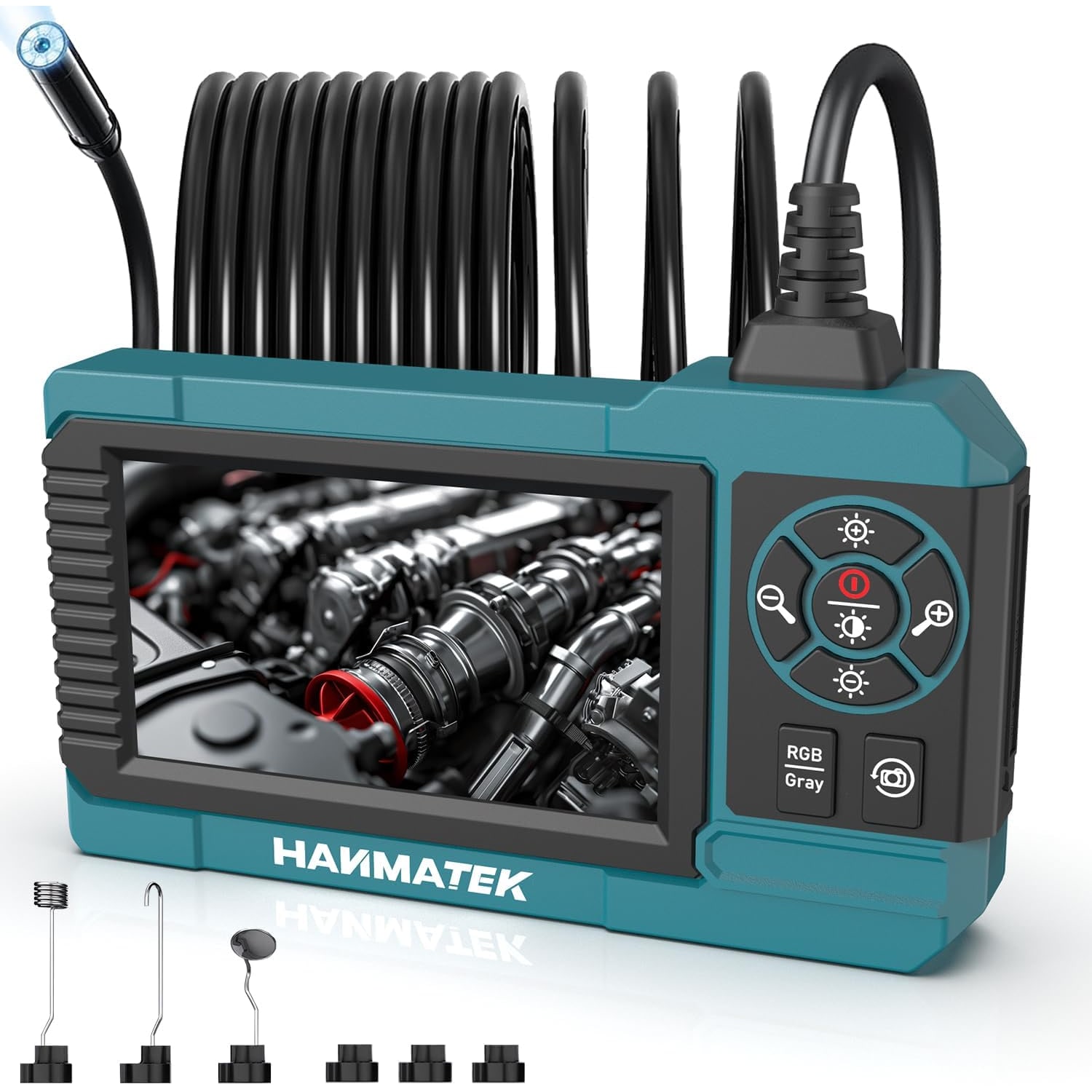
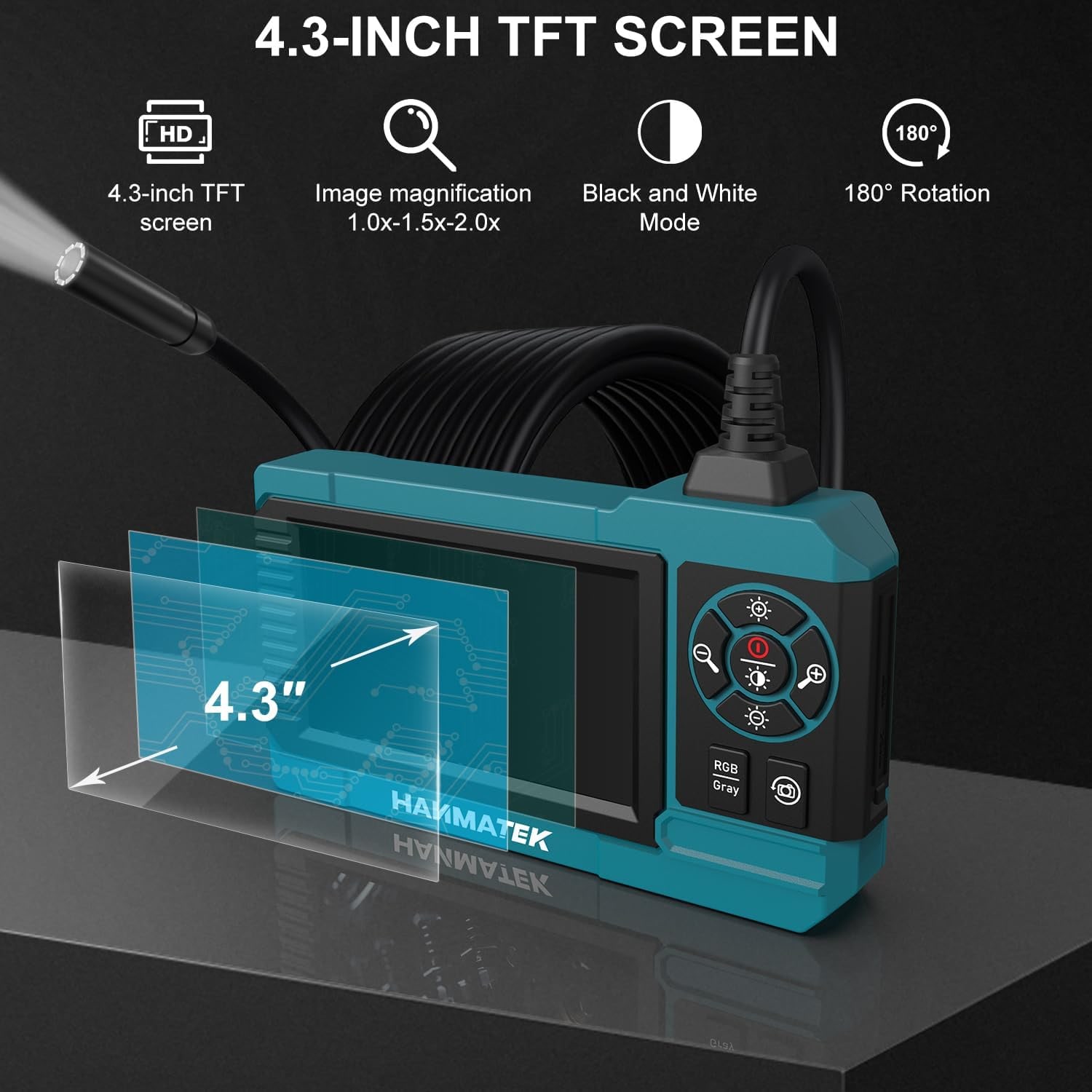
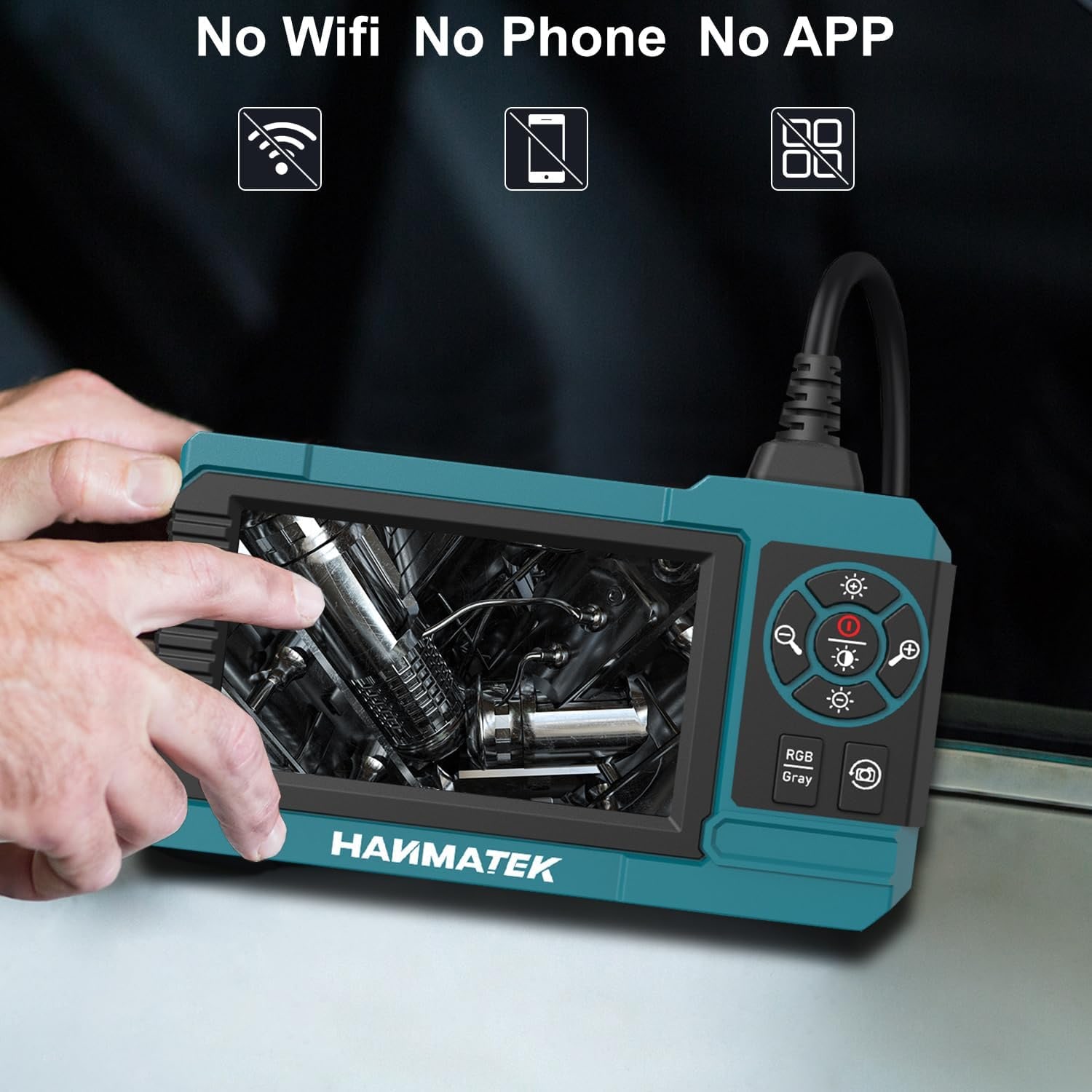
There are two families of inspection camera. One sends its picture to a phone. The other has a screen built in. This model is the second sort, with a 4.3 inch TFT display on the handset and the battery inside it.
The benefit is that everything is in one piece. There is no app to open and no signal to join. You pick it up, switch it on and look. In a workshop or a plant room, that matters. Hands are oily, the phone is in a pocket for good reason, and a tool that works alone is a tool that gets used.
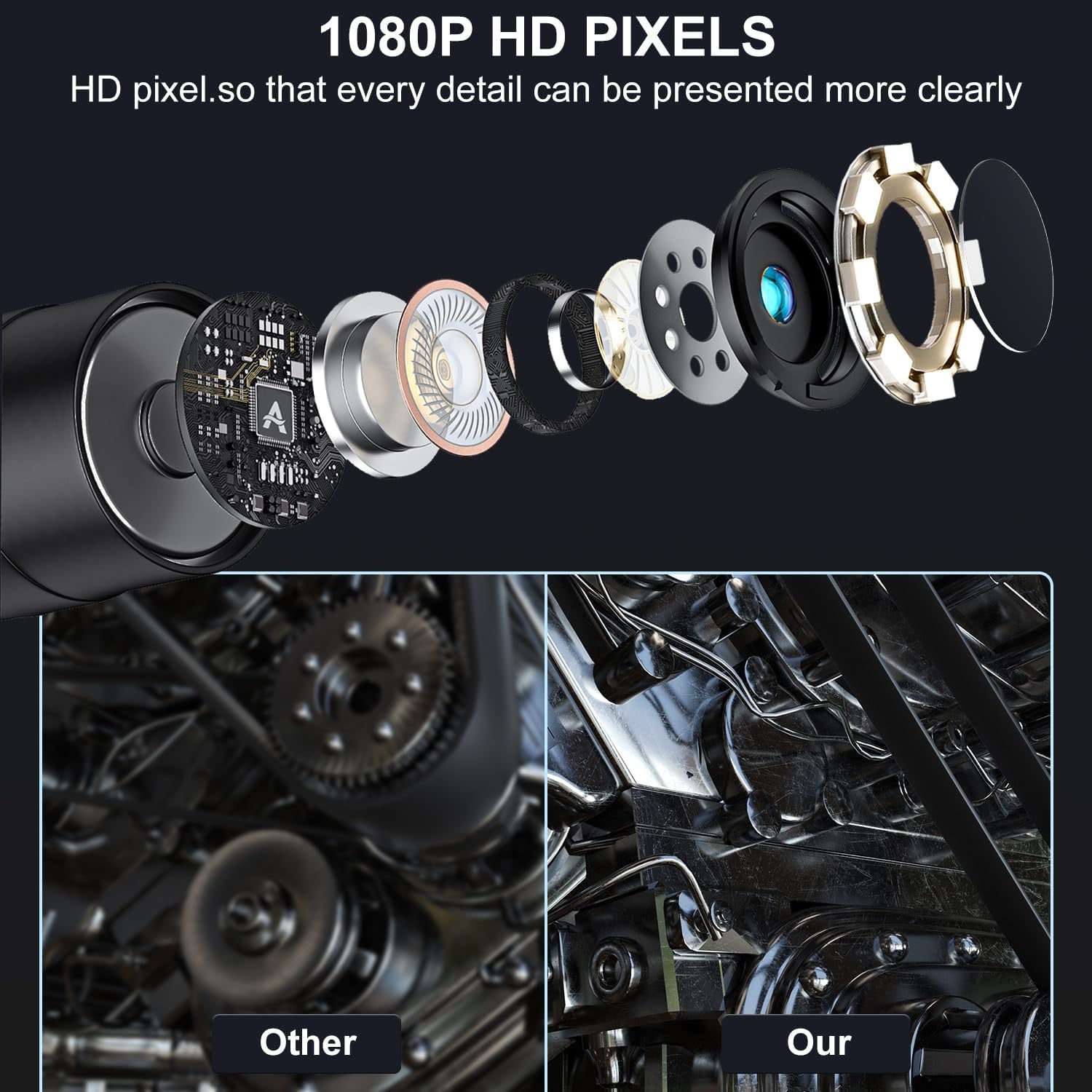
The maker describes the display as 1080p, and the specifications list a 2.07MP CMOS sensor. In day-to-day terms, you are looking for cracks, leaks, loose fittings, corrosion and foreign objects. A screen of this size shows those clearly at arm's length while your other hand guides the cable.
The controls that make it more than basic
Entry-level screen models show a picture and little else. This one adds a set of buttons that earn their keep.
Zoom comes first. One button steps through 1x, 2x and 3x. It is digital zoom, so it enlarges the middle of the picture and does not add new detail. Even so, it helps. When you have found a suspect mark on a cylinder wall or a pipe joint, making it bigger on screen is easier on the eyes than leaning in.
Then there is the picture flip. The maker calls it a 180 degree rotating display, and it is controlled by a button that turns the image 180 degrees. Anyone who has pushed a cable round two bends knows why this exists. The camera rolls over on the way in, and suddenly the water in the pipe appears to be on the ceiling. Twisting 5m of cable to correct it is slow and often fails. Pressing a button is instant.
The last control switches between colour and black and white. The maker does not say much about it. In practice a black and white view can make edges and scratches stand out when shiny metal fills the frame. Colour is still the mode you want for judging rust, scale or staining.
Getting your bearings on screen
A picture from inside a pipe has no horizon, and that throws people at first. Use water as your guide. Any liquid lies at the bottom, so if it appears at the top of the screen, press the rotate button and carry on. In a dry duct, look for dust, which also settles on the lower surface.
Work at 1x while you travel. Zoom narrows what you see and makes the picture jump with every small movement of the cable. Stop when something catches your eye, steady the cable against the edge of the opening, then step up to 2x or 3x. Drop the LED level a notch at the same time if the spot looks washed out. When you are done, go back to 1x before moving on, or you will lose your place within seconds.
8mm camera and eight LEDs
The camera is 8mm across. That is the measurement to check against your job, since nothing else matters if the camera cannot pass. Most trunking, drains, machine housings and engine access points take 8mm without trouble. Measure the tightest point on the route, not just the entry.
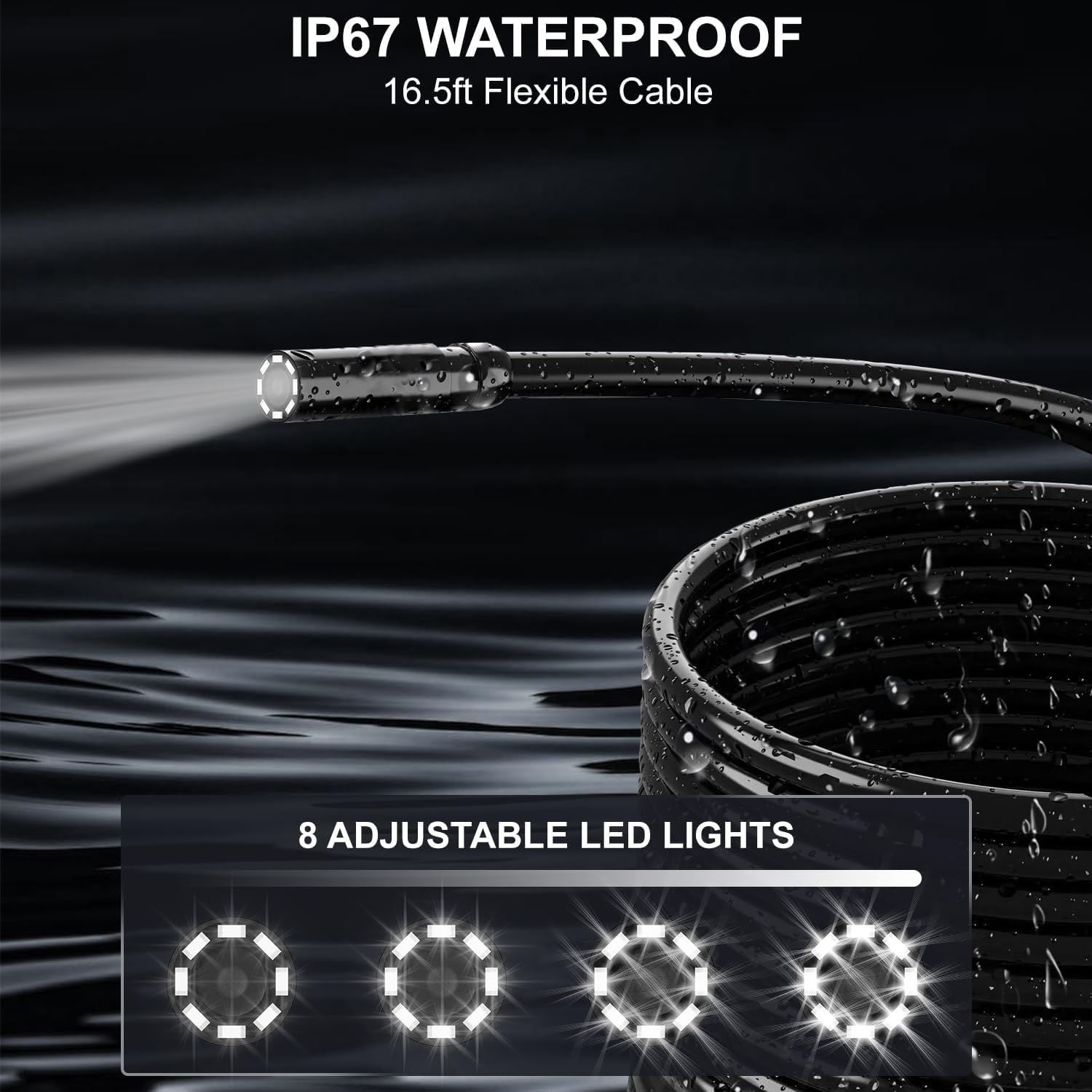
Eight LED lights surround the lens, with four brightness levels. Adjustable light is one of the more useful features on any inspection camera. In a dry, dark void you want all the light you can get. On wet pipe walls or bright metal, full power bounces back and bleaches the picture. Dropping a level or two usually brings the surface texture back.
There is no autofocus, and the maker does not describe a focus control. Sharpness is set by distance. Move the camera a little closer or further away until the detail is crisp, then zoom if you need to.
Five metres of flexible cable
Length is the reason to choose this over a short model. With 5m you can follow a pipe well beyond the first bend, reach across a wide ceiling void from a single access panel, or get deep into large equipment.
The maker describes the cable as flexible. It does not say whether it is semi-rigid, meaning whether it holds a curve once bent. That affects how well you can push the camera upward or across an open gap. For runs that lie along the bottom of a pipe or duct, a flexible cable is fine. If your work needs the camera to point up into a riser, ask us before you order.
A long cable needs handling. Feed it steadily, do not force it past a snag, and coil it loosely afterwards.
IP67 and its limits
The camera has an IP67 rating, and the maker says it is protected from dust and water for work in wet conditions. IP67 is the standard code for dust-tight and protected against short immersion.
The rating is stated for the camera. Nothing is said about the handset, which has a screen, buttons and a Type-C port. So the working rule is simple. The camera end can get wet. The handset stays dry.
No heat rating is given. Let engines, exhausts and hot pipes cool fully before an inspection.
Battery
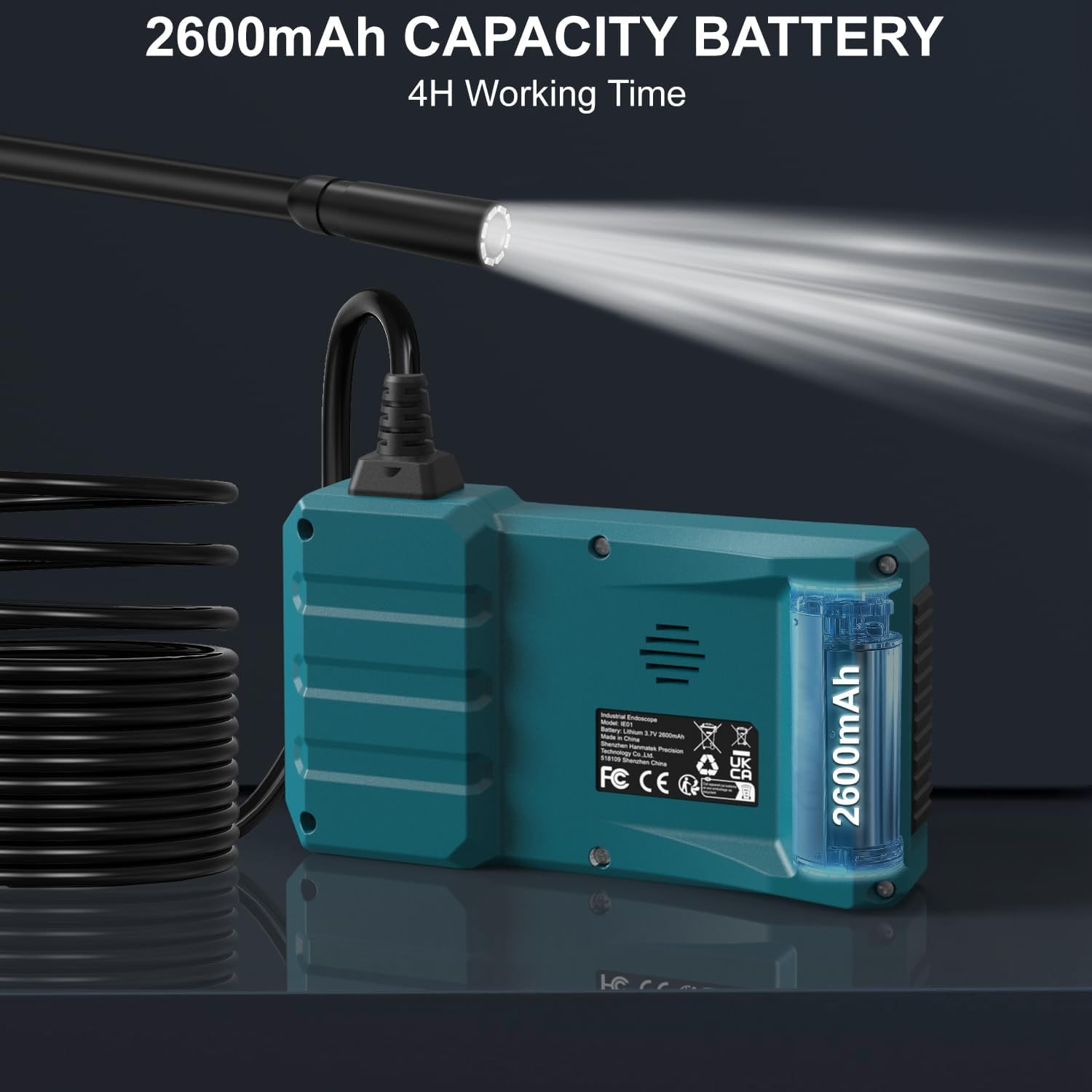
A 2600mAh lithium battery powers the unit, and the maker gives a figure of up to 4 hours of continuous use. That covers a lot of inspections, because a typical look takes minutes. Charging is by Type-C.
What the maker does not tell you
Some details are missing, and it is better to know before you buy.
The maker lists only the endoscope itself as box contents. It does not state whether a charging cable is included, and no wall charger is listed. Have a Type-C cable and a USB charger ready.
No hook, magnet or mirror is listed either. If retrieving dropped parts is half the reason you want a camera, pick a set that names those tips.
The specification table mentions JPEG and MP4 file formats, yet the maker does not describe a card slot, storage or a record button. Until that is confirmed, treat this as a live viewer. If you must attach images to a job report, ask us to check first.
Who it suits
This endoscope fits people who inspect regularly: mechanics, aircon and plumbing technicians, building maintenance staff, and home owners who take repairs seriously. The long cable, the zoom and the picture flip all save time on awkward jobs.
In a flat or condominium, it is handy for drain lines, aircon trunking and ceiling voids. In the car park, it reaches under and behind a cold engine. In an office or small factory, it gets into ducting and machine housings.
It is less suited to someone with one small job and no plans for another. A short phone-based camera costs less. And at 0.58 kg it is a proper handheld tool, not a pocket gadget.
Care in humid weather
Heat and humidity shorten the life of any electronic tool. Wipe the camera and cable after each use and dry them fully. Clean the screen with a soft dry cloth. Keep the Type-C port free of dust and moisture. Store the unit in a dry, shaded cupboard, and do not leave it in a parked car. If it sits unused for a long stretch, give the battery a top-up every few months.
The short version
This is a self-contained inspection camera for people who need reach and control. You get a 4.3 inch screen, an 8mm IP67 camera, 5m of flexible cable, eight LEDs with four levels, 3x digital zoom, a 180 degree picture flip and up to 4 hours of battery.
Check your opening size, have a Type-C cable ready, and ask us first if you need recording or retrieval tips. For looking deep into pipes, engines and machinery, it covers the ground well.